July 19, 2026 • Celeste Morrow • 9 min reading time • Prices verified June 4, 2026
Post-Acne Mark Erasers: Retinol, Niacinamide, and TXA Combos Ranked by Scar Type
If you’ve ever cleared a breakout only to stare at a red or brown ghost of it for months afterward, you know the particular frustration of post-acne marks. These marks aren’t technically scars — they don’t involve a change in skin texture — but they can feel just as stubborn. The two main types have different causes and respond better to different treatments. PIE (post-inflammatory erythema) is the pink or red flush left when capillaries near the surface are disrupted; it’s a vascular response. PIH (post-inflammatory hyperpigmentation) is the brown or tan discoloration caused by excess melanin — the pigment your skin overproduces in response to inflammation. As Self’s 2024 explainer on acne scars notes, confusing the two is the most common reason people stay on the wrong product for too long.
This guide ranks the most-discussed products across those two mark types, breaks down how retinol, niacinamide, and tranexamic acid (TXA) each work, and maps the real-world layering questions buyers keep asking in verified reviews.
| EDITOR'S PICKAnua Niacinamide 10 + TXA 4 Ser… | Mid-tierCeraVe Resurfacing Retinol Seru… | Budget pickThe Ordinary Niacinamide 10% +… | |
|---|---|---|---|
| Key actives | Niacinamide 10, TXA 4 | Retinol, Licorice Root, Niacinamide | Niacinamide 10%, Zinc 1% |
| Target | Dark spots | Post-acne marks | Blemishes |
| Texture | Lightweight | — | — |
| Size | 1.01 fl oz | — | 1 fl oz |
| Skin barrier focus | — | ✓ | — |
| Pore minimizing | — | ✓ | — |
| Price | $21.85 | $18.68 | $6.00 |
| See on Amazon → | See on Amazon → | See on Amazon → |
What Each Ingredient Actually Targets
Before ranking products, it helps to understand which molecules are doing which jobs — because the formulas people love often combine two or three of these, and the sequencing matters.
Retinol (a vitamin A derivative) accelerates cell turnover, pushing pigmented or damaged cells to the surface faster than they’d travel on their own. Byrdie’s roundup of dermatologist-recommended retinol serums for acne scars notes that this mechanism makes retinol particularly effective for both PIH and flattening shallow textural irregularities, but it does nothing to address the vascular component of PIE. It’s also the ingredient most likely to cause purging or irritation, especially when reintroduced after a break or used alongside other actives.
Niacinamide (vitamin B3) works primarily by interfering with the transfer of melanin from melanocytes to surface skin cells — the precise step that creates PIH discoloration. Paula’s Choice’s ingredient encyclopedia describes niacinamide as one of the most well-researched and well-tolerated brightening actives, effective across concentrations from 5% to 20%, with higher percentages showing stronger results for deeper pigmentation.
Tranexamic acid (TXA) is the newest of the three in mainstream skincare. It works by blocking the pathway that triggers excess melanin production in the first place — upstream of where niacinamide intervenes. Allure’s 2024 overview of TXA explains that it was originally used as an injectable medication to reduce surgical bleeding, but topical concentrations of 2–5% have shown meaningful results for PIH and melasma in clinical trials. Crucially, TXA also has some effect on PIE because it reduces inflammatory signaling, not just pigment transfer — making it one of the more versatile ingredients in this category.
By the Numbers
| Ingredient | Primary target | Typical effective % | Onset (consistent use) |
|---|---|---|---|
| Retinol | PIH, texture | 0.025%–0.3% | 8–16 weeks |
| Niacinamide | PIH (melanin transfer) | 5%–20% | 4–12 weeks |
| TXA | PIH + some PIE | 2%–5% | 4–8 weeks |
The Products Ranked by Scar Type
Best for PIH (Brown Marks): The Niacinamide + TXA Stack
JUMISO Glow Awakening Niacinamide 20% Serum is the product that draws the most striking head-to-head comparisons in verified buyer reviews. One returning buyer with significant melasma and sun damage describes it as more effective than a prescription brightening regimen they’d previously used, specifically calling out the 20% niacinamide combined with TXA and glutathione (a brightening antioxidant) as the differentiator. That’s a meaningful data point: prescription-compare language from a buyer with established melasma is not the kind of claim casual reviewers make.
The trade-off here is concentration sensitivity. Paula’s Choice’s niacinamide guide notes that while niacinamide is generally well-tolerated, very high percentages can occasionally cause flushing in reactive skin — a paradoxical “niacin flush” effect that usually resolves in the first few weeks but can alarm new users. If you have very sensitive or rosacea-prone skin, the jump to 20% niacinamide should be gradual (alternate nights to start).
Anua Niacinamide 10% + TXA 4% Dark Spot Correcting Serum wins on speed. Across verified reviews, the pattern is consistent: buyers report visible fading of blemish marks within days to a couple of weeks rather than months. The most striking documented case involves a two-year-old red mark — technically PIE that had become chronic — fading after Anua use when nothing else had moved it. At 10% niacinamide and 4% TXA, this formula is meaningfully gentler than JUMISO while still covering both the melanin-transfer pathway and the inflammatory/vascular component.
Decision frame for PIH: If your marks are fresh (under three months old) or moderate, Anua’s concentration is well-matched and the onset speed is well-documented by reviewers. If you’re dealing with older, deeper brown marks or melasma, JUMISO’s higher-concentration stack is where the experienced-buyer evidence points — but introduce it slowly.
Best for PIE (Red/Pink Marks): Retinol-Forward Formulas
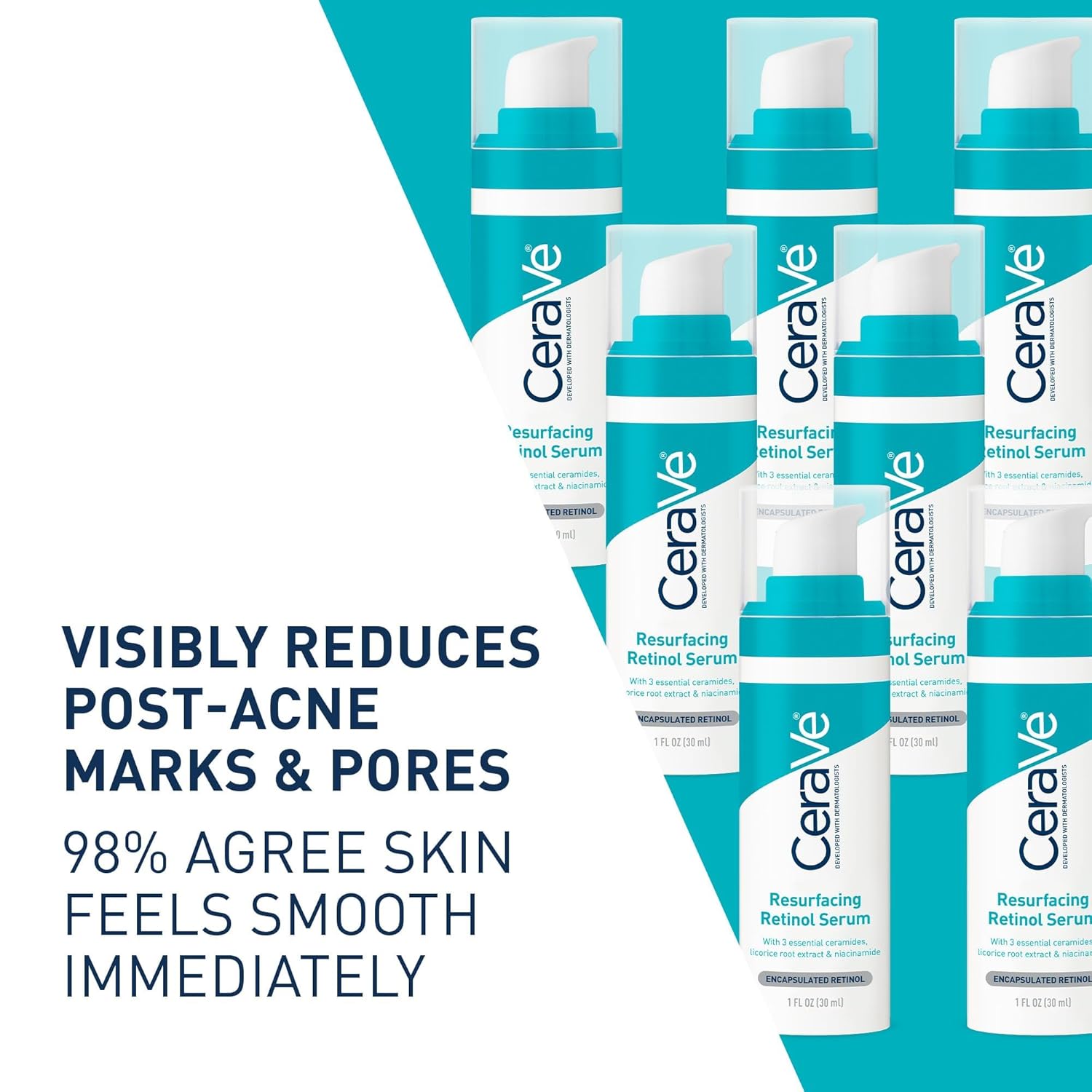
CeraVe Resurfacing Retinol Serum has a specific buyer profile worth understanding: people returning to retinol carefully — after pregnancy, after an extended tolerance break, or for the first time after previous irritation. One reviewer documents cystic-acne scarring on cheeks and temples fading with consistent CeraVe retinol use alongside prescription clindamycin (an antibiotic gel). That pairing — retinol for turnover, an antibiotic for active bacterial load — is a real clinical workflow that dermatologists sometimes use in stages, and this buyer’s documented experience aligns with the American Academy of Dermatology’s framework for managing post-inflammatory changes alongside active acne treatment.
CeraVe’s formula pairs retinol with encapsulated niacinamide, ceramides (skin-barrier lipids), and licorice root extract — a combination that buffers the retinol’s irritation potential while adding a secondary brightening mechanism. Byrdie’s dermatologist-sourced roundup highlights this approach as particularly smart for acne-prone users because it doesn’t require you to build a separate barrier-repair step.
PIE responds to retinol indirectly — by reducing inflammation and accelerating turnover of damaged vascular skin cells — but it’s a slower path than TXA for this purpose. Expect 10–16 weeks for meaningful PIE improvement with retinol alone.
When You Need Both: Combination Marks
Many buyers, especially those who’ve had moderate-to-severe acne, are dealing with both PIH and PIE simultaneously — different marks from different breakouts at different stages. This is where the layering question becomes the actual purchasing decision.
The buyer pattern in verified reviews shows that Anua TXA serum + CeraVe retinol is a popular pairing — but it comes with real caveats. Reviewers who layer both without buffering (applying both directly without a moisturizer between) report irritation at a higher rate. The safe protocol, consistent with how Allure and Byrdie both frame TXA + retinol layering: apply TXA serum first (thinner, water-based), let it absorb fully (3–5 minutes), apply a lightweight moisturizer, then apply retinol on top of or over the moisturizer. This sandwich technique drops retinol’s irritation potential significantly.
Decision frame for combination marks: Anua TXA for the morning routine (it’s photostable), CeraVe retinol in the evening with moisturizer buffering. Don’t layer them in the same step. Expect 8–12 weeks before a meaningful read on whether the combination is working.
Where the Evidence Thins Out — and the Trade-offs Worth Naming
High niacinamide on rosacea-prone skin: The JUMISO 20% formula is outstanding for PIH, but rosacea-prone skin is a different context. The Journal of Clinical and Aesthetic Dermatology’s 2021 evidence review on TXA notes that TXA’s anti-inflammatory properties are well-documented, while very high niacinamide concentrations show mixed tolerability in reactive skin conditions. If rosacea is part of your picture, Anua’s 10% niacinamide + 4% TXA is a more conservative starting point, and seeing a dermatologist before introducing any active at high concentration is genuinely reasonable advice.
Prescription clindamycin and retinol together: Buyers who pair these report good results — and the dermatology rationale is sound (antibiotic addresses bacterial component, retinol addresses cellular turnover and pigmentation). But this combination means your skin is already doing significant active work, and adding a TXA serum on top of that stack without introducing it gradually is where the irritation reports cluster. The practical rule: one new active at a time, minimum two-week intervals between introductions.
Depth matters: None of these actives meaningfully address atrophic (pitted or indented) scarring. Depressed scars involve collagen loss, not surface discoloration — they require procedural intervention (microneedling, laser resurfacing, subcision) rather than topical products. If you’re uncertain whether your marks are flat discoloration or textural, this distinction is worth clarifying with a dermatologist before investing in a topical stack.
Frequently Asked Questions
What is the difference between a red post-acne mark (PIE) and a brown one (PIH), and does it change which product to use? Yes, significantly. PIE is vascular — damaged capillaries near the surface — and responds better to anti-inflammatory ingredients like TXA, plus time and sun protection. PIH is pigment-based and responds better to niacinamide (which blocks melanin transfer) and retinol (which speeds surface turnover). TXA addresses both, which is why it appears in so many cross-purpose formulas.
How long do I realistically need to use TXA or niacinamide before a mark fades? Anua reviewers consistently report faster-than-expected onset — days to a few weeks for fresh marks. But the clinical reality for moderate PIH is 4–12 weeks of consistent daily use, per niacinamide research summarized by Paula’s Choice. Older marks (over six months) often require 12+ weeks. Sun exposure resets the clock, so SPF 30+ daily is non-negotiable during any brightening treatment.
Can I use the CeraVe Resurfacing Retinol Serum at the same time as the Anua TXA serum, or will that cause irritation? You can use both, but not in the same step or the same application window. The pattern in reviews: Anua TXA in the morning (it’s stable under sunscreen), CeraVe retinol in the evening. If you want to use them on the same evening, apply TXA first, wait for absorption, apply moisturizer, then retinol. Skipping the moisturizer buffer is where irritation reports come from.
Is it safe to use a 20% niacinamide serum on very sensitive or rosacea-prone skin? Use caution. While niacinamide is broadly gentle, very high concentrations can trigger flushing in reactive skin, and rosacea-prone skin is already dealing with vascular reactivity. Allure’s TXA overview notes that TXA’s anti-inflammatory properties are often better tolerated for rosacea-adjacent concerns than high-dose niacinamide. Starting with Anua’s 10% niacinamide + 4% TXA and assessing tolerance over two weeks is the more conservative path.
Why did my dermatologist prescribe clindamycin but not address my scarring? Clindamycin targets the bacterial component of active acne — Cutibacterium acnes. It’s prescribed to reduce new breakouts, not to fade existing marks. Many dermatologists address the two issues in sequential steps: control active acne first, then introduce brightening actives. It’s not an oversight; it’s sequencing. The buyer-documented experience of pairing clindamycin with retinol and seeing mark improvement is consistent with this — the prescription handled new breakouts while the retinol handled the aftermath.
What should I apply first — the retinol serum or the TXA serum? TXA serum first. It’s typically water-based and thinner, so it absorbs better against clean skin. Retinol formulas are usually emollient-forward; applying retinol first can block TXA absorption. After TXA absorbs (3–5 minutes), apply your moisturizer, then retinol. This sequencing also buffers retinol’s irritation potential, which matters when you’re using multiple actives.