July 2, 2026 • Celeste Morrow • 9 min reading time • Prices verified June 4, 2026
Retinal vs. Retinol at Every Price: The Ordinary, Celimax, and When to Upgrade
If you’ve ever stood in a Sephora aisle staring at two products from the same brand — one labeled “retinol,” one labeled “retinal” — and wondered whether the extra syllable justifies the extra dollars, you’re in good company. Both are forms of vitamin A, the gold-standard ingredient for reducing fine lines, evening skin tone, and speeding up cell turnover (the process where your skin sheds old cells and generates fresh ones). But they are not the same molecule, and the difference matters in real, visible ways. This guide breaks down exactly what separates retinal from retinol, puts three specific products — The Ordinary Retinal 0.2% Emulsion, Celimax Vita A Retinal Shot, and The Ordinary Retinol 1% in Squalane — head to head, and gives you a clear decision framework for where you are right now in your retinoid journey.
| EDITOR'S PICKCeraVe Anti Aging Retinol Serum… | Mid-tierCeraVe Resurfacing Retinol Seru… | Budget pickThe Ordinary Retinol 1% in Squa… | |
|---|---|---|---|
| Retinol form | Encapsulated | — | — |
| Key ingredients | Hyaluronic acid, niacinamide, ceramides | Licorice root extract, niacinamide | Squalane |
| Target concern | Wrinkles, fine lines, brightening | Post-acne marks, pores, brightening | Anti-aging, smoothing |
| Size | — | — | 1 Fl Oz |
| Price | $20.44 | $18.68 | $9.90 |
| See on Amazon → | See on Amazon → | See on Amazon → |
Retinal vs. Retinol: The Molecule Gap That Changes Everything
Here is the chain that matters: your skin converts vitamin A derivatives into retinoic acid, which is the active form that actually talks to your skin cells. Retinol requires two conversion steps to get there. Retinal (also called retinaldehyde) requires only one.
That single saved step is not a marketing footnote. Byrdie’s overview of retinal vs. retinol cites research showing retinaldehyde can be up to 11 times more potent than retinol at equivalent concentrations — meaning a 0.2% retinal formula may deliver a biological punch closer to a 0.5–1% retinol product, depending on formulation. Allure’s deep dive on retinaldehyde adds the important caveat that retinal is also significantly harder to stabilize in a formula: it oxidizes quickly when exposed to air and light, which is why the few brands that use it tend to charge more, package carefully (think opaque tubes and airless pumps), and keep concentrations modest.
Self.com’s dermatologist roundup frames the potency hierarchy cleanly: prescription retinoic acid (tretinoin) sits at the top, retinal sits just below it, and retinol is the next rung down — still effective over time, but requiring more patience. For the practitioner-level reader who has already cycled through a basic retinol and is asking “is it time?” — that hierarchy is your decision map.
Why This Matters for Buying
The potency gap means your tolerance history is the most important variable in choosing between these two forms. Owners who report being “burned” by previous retinoids — the redness, peeling, and sensitivity that comes from moving too fast — frequently credit gentler retinol formulas with helping them rebuild their skin’s resilience before stepping up. Reviewers who come to retinal products with six-plus months of retinol use behind them report dramatically smoother transitions. Your conversion enzyme activity and skin barrier condition are the real inputs; the percentage on the label is only a proxy.
The Three Products: What Owners and Reviewers Actually Report
The Ordinary Retinal 0.2% Emulsion
This product has developed a reputation that outpaces its price point, and the review record is unusually specific — a signal worth paying attention to. Owners include a reviewer who began a serious skincare routine at 40 and credits visible capillary improvement and gradual skin-thickness changes to consistent retinal use over months. Another recurring detail in the review set is milia clearing (those tiny white keratin bumps under the eyes) — a granular observation that tends to come from genuine, methodical users rather than surface-level impressions.
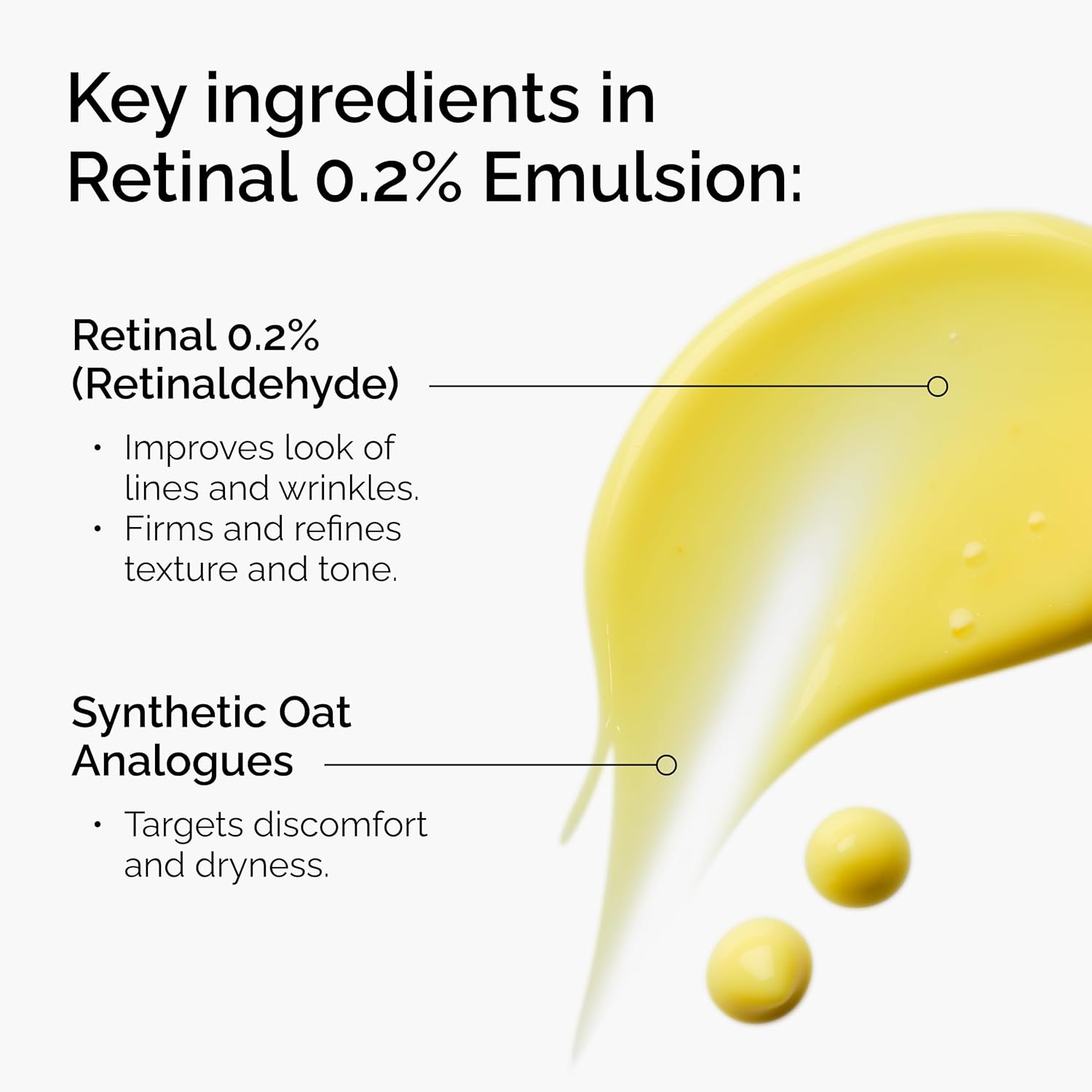
The emulsion texture is routinely praised for making the formula approachable: it delivers the retinal in a moisturizing base rather than a serum, which Paula’s Choice’s formulation guides note is a meaningful buffering strategy for high-actives. The 0.2% concentration is low enough to be a genuine entry point to retinal, but given the potency differential above, it is not a beginner product in the way a 0.025% retinol would be. Allure’s retinaldehyde coverage recommends that even low-concentration retinal products be introduced slowly — every third night, then every other night — before nightly use.
Who it’s for: Retinol veterans with at least six months of consistent, tolerant retinol use who want to step up without committing to a prescription or a $150+ bottle.
Celimax Vita A Retinal Shot
Celimax markets this product around stabilized nano-retinal — a particle-size reduction technology intended to improve skin penetration and reduce surface irritation. Reviewers describing it as “professional-grade” and “clinic-level” are responding partly to that positioning, though it’s worth noting that the review set here skews heavily toward short-term texture impressions (skin feels smoother, tone looks more even within a few weeks) rather than the longer-arc transformation reports you see for The Ordinary’s retinal.
That shorter review window isn’t a disqualifier — it may reflect a newer product and a slightly different buyer profile (K-beauty shoppers who prioritize finish and glow over extended clinical tracking). But the intermediate practitioner who is building a serious retinoid protocol should weight The Ordinary’s denser long-term evidence base more heavily than Celimax’s early-impression reviews. Celimax earns a real place in this lineup for users who want a retinal in a more emollient, K-beauty-adjacent texture profile and are willing to trade some long-run data depth for a smoother application experience.
Who it’s for: Retinoid-experienced users whose primary barrier to upgrading is texture — specifically those who found serum-format retinoids too drying or irritating.
The Ordinary Retinol 1% in Squalane
This is the methodical user’s product. The review record here is distinctively careful: one reviewer tracked remaining bottle volume against weeks of use (noting “70% left after 5.5 weeks”) in a way that signals a reader who is measuring, adapting, and taking their retinoid seriously. Squalane (a lightweight, non-comedogenic oil derived from olives or sugarcane) serves as the delivery base and buffer — Paula’s Choice’s retinol guide specifically identifies oil-based buffers as an effective strategy for reducing initial retinol irritation without meaningfully compromising efficacy over time.
At 1%, this is the highest concentration retinol The Ordinary offers, and owners report the kind of skin changes — fine line softening, texture refinement, tone evenness — that take three to six months of consistent use to appear. The “surprised it worked” note is strikingly common across reviews from people who had previously abandoned retinoids after bad experiences with harsher formulas. That pattern suggests the squalane base is doing meaningful work.
Who it’s for: Retinoid newcomers ready to commit to a real protocol, and experienced retinol users who want the highest-concentration retinol before making the jump to retinal.
By the Numbers
| Product | Retinoid Form | Concentration | Approx. Equiv. Retinol Potency | Format |
|---|---|---|---|---|
| The Ordinary Retinal 0.2% Emulsion | Retinal | 0.2% | ~1–2% retinol range | Emulsion |
| Celimax Vita A Retinal Shot | Nano-retinal | Undisclosed | Comparable to low retinal | Serum/ampoule |
| The Ordinary Retinol 1% in Squalane | Retinol | 1.0% | 1% retinol baseline | Oil/serum |
Potency equivalency estimates based on published conversion-step research cited in Byrdie and Allure coverage; individual results vary by skin enzyme activity and formulation.
The Upgrade Decision: If X, Then Y
This is where the practitioner framing earns its keep. The question isn’t “which product is better” in the abstract — it’s “which product is right for where I am.”
If you are new to retinoids (under three months of use, or any history of significant irritation, peeling, or barrier disruption): Start with The Ordinary Retinol 1% in Squalane at a reduced frequency — three nights per week, built slowly. The squalane buffer and the transparent concentration make this the most controllable introduction to serious retinoid use available at its price.
If you have six-plus months of stable retinol tolerance and want to accelerate results: The Ordinary Retinal 0.2% Emulsion is the upgrade that the evidence supports. The owner reviews have the depth and specificity that suggest real efficacy, and the emulsion base manages the higher potency without requiring a full tolerance reset.
If texture is your primary friction with retinoids: Celimax Vita A Retinal Shot is a credible alternative, particularly if you are already invested in a K-beauty layering routine and want a retinal that integrates smoothly. Commit to a minimum three-month evaluation window before judging results — short-term texture impressions are not the full story with any retinoid.
If you are weighing retinol vs. retinal purely on price: The Ordinary’s retinal costs more than its retinol, but the per-use math narrows when you account for the lower effective concentration needed and the slower build of use frequency. Self.com’s dermatologist commentary consistently frames retinal as a meaningful clinical step up — not a marketing upgrade — which changes the value calculus for users who have plateaued on retinol.
Frequently Asked Questions
What is the difference between retinal and retinol, and which is stronger? Both are vitamin A derivatives that your skin converts into retinoic acid — the active form that drives cell turnover and collagen production. Retinol requires two conversion steps; retinal requires only one. That efficiency makes retinal meaningfully more potent at equivalent concentrations. Per Byrdie’s comparison, retinal may be up to 11 times more potent than retinol, gram for gram.
Is The Ordinary Retinal 0.2% suitable for beginners, or only experienced retinoid users? Despite the modest-sounding 0.2% figure, this is not a beginner product. Because retinal is substantially more potent than retinol per percentage point, Allure’s retinaldehyde coverage recommends reserving retinal formulas for users with an established retinoid tolerance. If you haven’t used retinol consistently for at least four to six months without significant irritation, start with retinol first.
Can I use a retinal product if I am also using a niacinamide serum? Yes — niacinamide and retinoids are generally compatible, and Paula’s Choice’s ingredient education notes that niacinamide’s barrier-supporting and anti-inflammatory properties can actually help offset retinoid-related irritation. Use niacinamide in your morning routine or apply it before your retinal on retinoid nights as a buffer layer. Avoid layering retinal directly with vitamin C (ascorbic acid) on the same application — the pH conflict can reduce the efficacy of both.
Why does retinal cost more than retinol, even at the same brand? Stabilization. Retinal oxidizes quickly when exposed to light and air, and formulating it into a stable, shelf-viable product requires either specialized packaging (airless pumps, opaque tubes) or encapsulation technology (as in Celimax’s nano-retinal approach), or both. Allure’s coverage of retinaldehyde explains the formulation challenge clearly: the ingredient is more expensive to source and harder to keep active through a product’s shelf life, and that cost passes through to retail price.
How do I know when I am ready to move from retinol to retinal? The clearest signal is tolerance stability: if you have been using a mid-to-high concentration retinol (0.5–1%) three to five nights per week for at least four to six months without meaningful redness, peeling, or tightness, your skin barrier is likely ready. A secondary signal is results plateau — if you have been consistent but stopped seeing improvement in texture or tone, you may have extracted most of what retinol can deliver at your current concentration, and retinal is the logical next step before committing to a prescription formula.